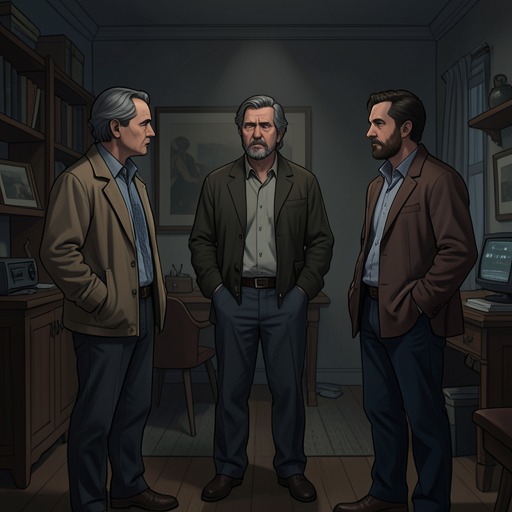
Zhivago's funeral and Lara's return
Doctor ZhivagoZhivago's funeral and Lara's return bring Larisa Feodorovna Antipova back into Yurii Andreievich Zhivago’s life at its end: she arrives unexpectedly at his funeral, meets his brother Evgraf, and learns that the apartment where the body lies holds an intimate history she had not known. The scene is at once a practical gathering organized around a civil cremation and a private reckoning with losses that remain unresolved. Its final act is Larisa’s solitary farewell at the coffin, a ritual that briefly makes room for grief amid the crowd and the procedures of death.
The funeral and its quiet organizers
Yurii’s body is brought to the flat on Kamerger Street, his last registered address, and left in the hall until the coffin arrives and the living room is prepared. Marina, his partner, initially grieves with overwhelming intensity. By the following day her outburst has subsided into numbness: she has stayed through the night, and the baby has been brought to her to feed. Her father Markel, her mother and sisters, and Yurii’s friends Misha Gordon and Innokentii Dudorov are among those gathered. The mourning is shared, but not evenly expressed: Marina sits exhausted while her father sobs beside her and other relatives come and go.
Two figures nevertheless acquire an authority no one contests: a man and a woman who do not claim to be closer to Yurii than the other mourners, yet appear to have taken responsibility for the funeral. They arrange its details with composure, and whenever they enter the room the others rise and withdraw, leaving them alone behind half-closed doors. The man is Evgraf, Yurii’s brother; the woman is Larisa. Their calm does not mean that they regard the death as insignificant. Rather, the gathering presents them as people who have accepted its finality and are occupied with what must still be done.
Evgraf explains that the cremation is scheduled for that night and that representatives of the Medical Workers' Union will take the body to their club. A civil ceremony is set for four o’clock. Yurii’s documents complicate the arrangements: his workbook is out of date, he has not exchanged his old union card for a new one, and his dues have gone unpaid for years. Evgraf has had to put these matters in order. The passage gives the funeral a distinctly administrative setting, where paperwork and institutional procedure accompany personal loss rather than displacing it.
Larisa’s return to Kamerger Street
Evgraf asks Larisa not to disappear after the cremation. He wants her help to sort Yurii’s papers, and proposes that they remain in the same building, or nearby, for the few days the work will require. Larisa agrees. She has come to Moscow only recently, after being away so long that much of the city has become unfamiliar. Walking through its streets, she recognizes Kamerger Street and discovers the house where her husband, Pavel Antipov, once lived as a student. She does not know that the tenants and circumstances have changed. She enters the building looking for the people she remembers and instead finds a crowded room and Yurii’s coffin.
The place joins two histories without warning. Larisa had not known that Yurii’s final flat was also the room in which Pavel had lived. Evgraf says that neither he nor Yurii knew of that connection. For Larisa, the recognition is part of the shock of finding a dead man where she had expected to encounter an old address and perhaps familiar occupants. Her return is therefore not a planned visit to Yurii: it is an accidental encounter with his death, made more startling by the apartment’s connection to her own past.
The conversation also exposes a lasting disagreement over Pavel’s fate. Larisa says she has heard that he died by suicide, but does not believe it; she insists that Pavel was not a man who would take his own life. Evgraf answers that the report is certain. Pavel shot himself in the same house, soon after Larisa had left for Vladivostok, and Yurii found and buried him. Larisa had never been told. The disclosure links the two men through an act of care and places the missed news of Pavel’s death beside the news of Yurii’s: Larisa’s understanding of her past is altered even as she mourns a second loss.
Manuscripts, memory, and the missing child
Larisa promises to stay and help with Yurii’s manuscripts. She says that she knows his handwriting intimately, having learned its every turn through years of closeness, and that working on the papers will comfort her. The task is practical, but it is also a way to remain connected to a person she has just found dead. Evgraf, in turn, asks her to leave an address and not go away before they have completed the work. Their agreement establishes a brief shared purpose in the aftermath of the funeral: preserving and sorting what Yurii has left.
Larisa also needs Evgraf’s help with a separate and frightening matter concerning a child. She asks whether there is a central source that could identify children’s homes across the country or keep records of abandoned children. The question indicates her wish to trace a child who was placed with strangers to be brought up; she does not explain the circumstances, and the exchange does not resolve the search. She asks to postpone the conversation until after the crematorium, describing her anxiety and uncertainty about what to do next. The problem remains open beside the work on Yurii’s papers, placing a possible future search in the same room as a completed death.
She says she has come to Moscow without her daughter, Katia, in order to make arrangements for the girl’s education. Larisa describes Katia as gifted at music and acting, able to imitate people, invent scenes, and sing operatic arias by ear. She hopes to find a place for her in the junior classes of either a drama school or the Conservatory, and to apply for a scholarship before returning for her. These plans reveal the immediate practical concerns Larisa carries into the funeral: even in grief, she is trying to secure her daughter’s future and gather information for another search.
The last farewell
Evgraf responds to Larisa’s distress by offering help and urging her not to despair. He says that hope and action are duties in misfortune, then goes to admit the mourners and fetch the footstool she has requested. The object answers a simple practical need: without it, she cannot reach the coffin to kiss Yurii. It also prepares the scene’s final separation. While the crowd gathers and moves through the room, Larisa becomes absorbed in her thoughts and finds it difficult to attend to the funeral around her.
She regrets that Yurii is not receiving a church funeral, which she believes would have suited him. At the same time, remembering him brings back a sense of freedom and unconcern that she associates with his presence. Her grief and pride in him coexist: she longs to escape, briefly, the sorrows enclosing her, yet also wants the opportunity to mourn him without hindrance. When the others leave the room, she steps onto the footstool, crosses herself three times over the body, and kisses his forehead and hands. She then remains bowed over the coffin and flowers, shielding them with her arms and her whole posture. At last her restrained sobs break through.
The scene closes not with a resolution of Larisa’s questions but with a farewell. Evgraf has opened a path toward the manuscripts and offered assistance; the story of Pavel’s death has been confirmed, though its earlier concealment remains painful; and the search connected with a child is still only beginning. Against the civil arrangements and the crowded household, Larisa’s brief act at the coffin gives the funeral its most private center. Her return has brought her into contact with Yurii’s death, with the room’s hidden past, and with the unfinished responsibilities she must carry away.